Construa sua estratégia de carteiras de stablecoin

1. Introdução
Seus usuários querem enviar e receber dinheiro instantaneamente através das fronteiras. A tecnologia de stablecoin torna isso possível. Uma pesquisa da YouGov e da BVNK mostra que 77% dos usuários de stablecoin abririam uma carteira em seu aplicativo de fintech ou banco principal se ela fosse oferecida; eles só precisam que a experiência pareça nativa.
As empresas já estão usando a infraestrutura de stablecoin para fluxos de trabalho de pagamento. Em nossa plataforma, o volume de carteiras de stablecoin integradas cresceu 263 vezes em relação ao ano anterior. Clientes de PSPs e fintechs agora representam 75% desse volume (acima dos 58% de doze meses atrás), sinalizando que as stablecoins deixaram de ser um experimento nativo de cripto para se tornarem um uso corporativo convencional.
Nossos dados também mostram uma mudança em direção ao acesso financeiro 24/7. Metade de todas as transações de stablecoin em nossa plataforma ocorre fora do horário bancário, refletindo a demanda por uma infraestrutura de pagamento sempre ativa.
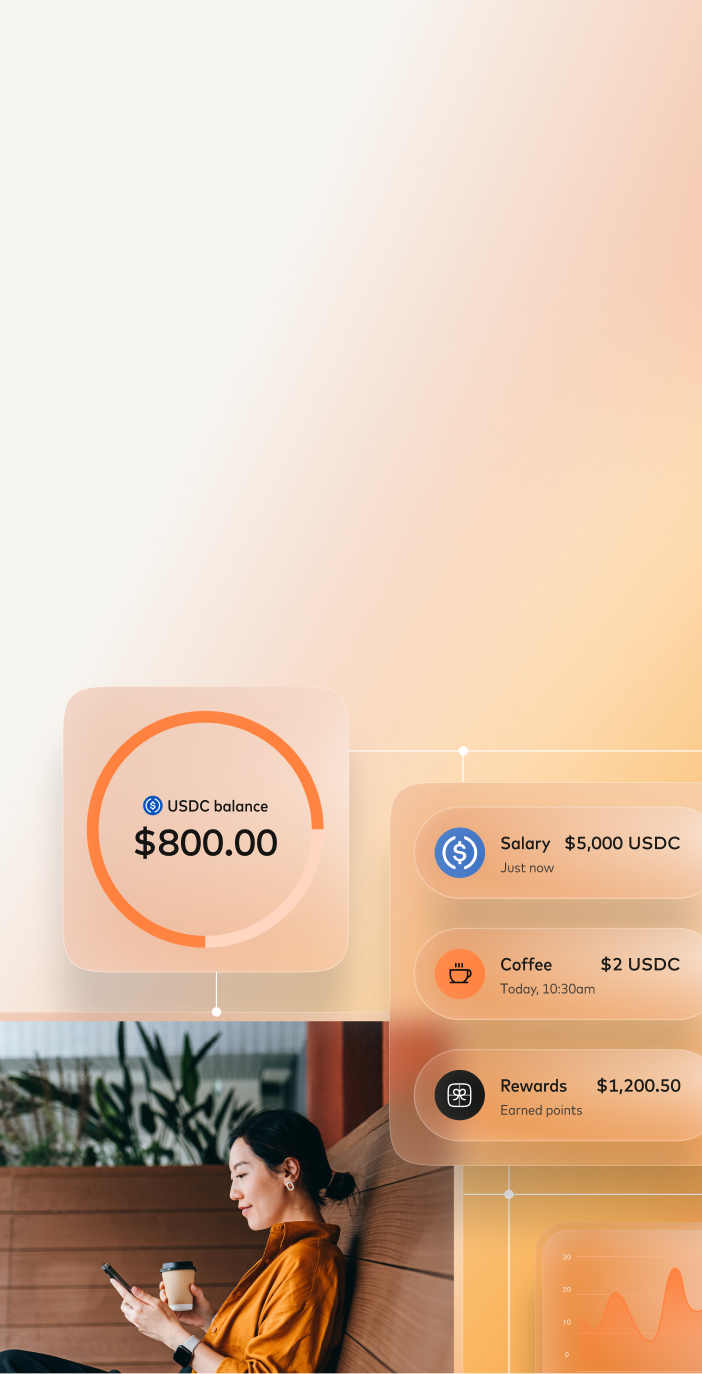
Para fintechs e grandes empresas, a carteira de stablecoin está se tornando o centro de gravidade de como os negócios movimentam dinheiro. É a interface onde enviar, receber, converter, gastar e ganhar acontecem em um só lugar. Uma única integração conecta stablecoins, moedas fiduciárias e redes de pagamento globalmente.
Lançar recursos de stablecoin costumava significar meses de atraso, estruturas de conformidade fragmentadas e complexidade com fornecedores. Isso não é mais necessário. Este guia documenta o que estamos observando em implementações corporativas – como as equipes estão avançando mais rápido, como são os modelos de carteiras integradas e o que é importante ao construir sua estratégia.
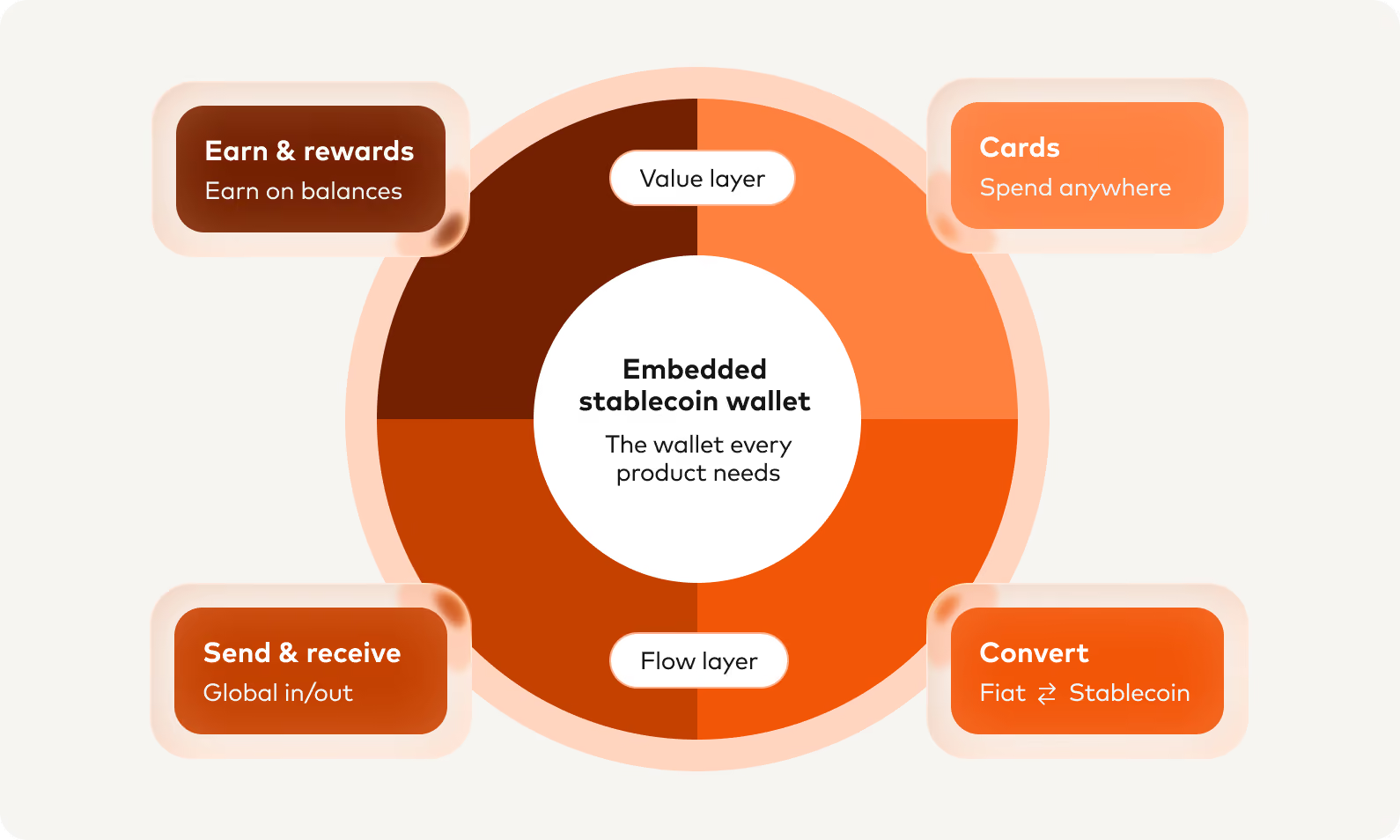
Stablecoin wallets extend value beyond global send/receive flows, enabling new revenue streams.
For product or compliance leaders exploring stablecoin wallets, this guide covers:
- Use cases: Real-world examples (B2B payments, payroll, remittances), fund flows and interactive demos.
- Where to launch: Global market signals and adoption metrics.
- How it works: Setup, responsibilities, compliance – what you control vs. your provider.
- Product capabilities: Features, onboarding and service levels.
- Building your experience: Design and rollout guidance.
- Pricing: Fee structures demystified and a guide to pricing your stablecoin service.
If you want to dig deeper, view our Stablecoin wallets 101 webinar session. Our team cover the fundamentals and discuss practical considerations for teams evaluating stablecoin wallets.
2. Explore use cases: what can you build?
Embedded stablecoin wallets enable businesses to send, receive, store, convert, spend and earn stablecoins. The most common use cases we see are:
- B2B payments: Send and receive payments cross-border with suppliers, merchants and partners, or your own entities.
- Salary and gig payouts: Enable international workers, sellers and creators to receive wages or earnings in stablecoins.
- P2P remittances:Faciliate peer to peer international transfers that end in stablecoins, are funded in stablecoins or use stablecoins to accelerate the middle of a transaction.
- Global digital dollar accounts: Give your customers a global dollar account backed by stablecoins for saving, spending, earning, or making payments.
Read on to learn about these, see what market leaders are building, and test drive solutions with our interactive API demos for B2B payments, Salary payouts and Global digital dollar accounts.
B2B payments
Businesses can send and receive payments cross-border with suppliers, merchants, partners, or their own entities using embedded wallets.
How it works – hold USD:
Your customer wants to hold USD but pay out to their suppliers in stablecoins.
- Fund: You or your customer fund a named wallet in USD/GBP/EUR in your platform (powered by BVNK).
- Initiate: Your customer selects to pay out in stablecoins in your platform.
- Send: BVNK automatically converts the fiat currency to stablecoins and sends to the supplier's wallet address.
How it works – hold stablecoins:
Your customer wants to hold stablecoin balances and pay out to their suppliers in stablecoins.
- Open: Your customer opens stablecoin wallet in your platform.
- Fund: Your customer moves funds from their fiat wallet to their newly open stablecoin wallet.
- Convert: BVNK converts the funds from fiat to stablecoin.
- Send/receive: Your customer sends stablecoin payouts to the receiver, BVNK ensures payout lands in the receivers wallet.
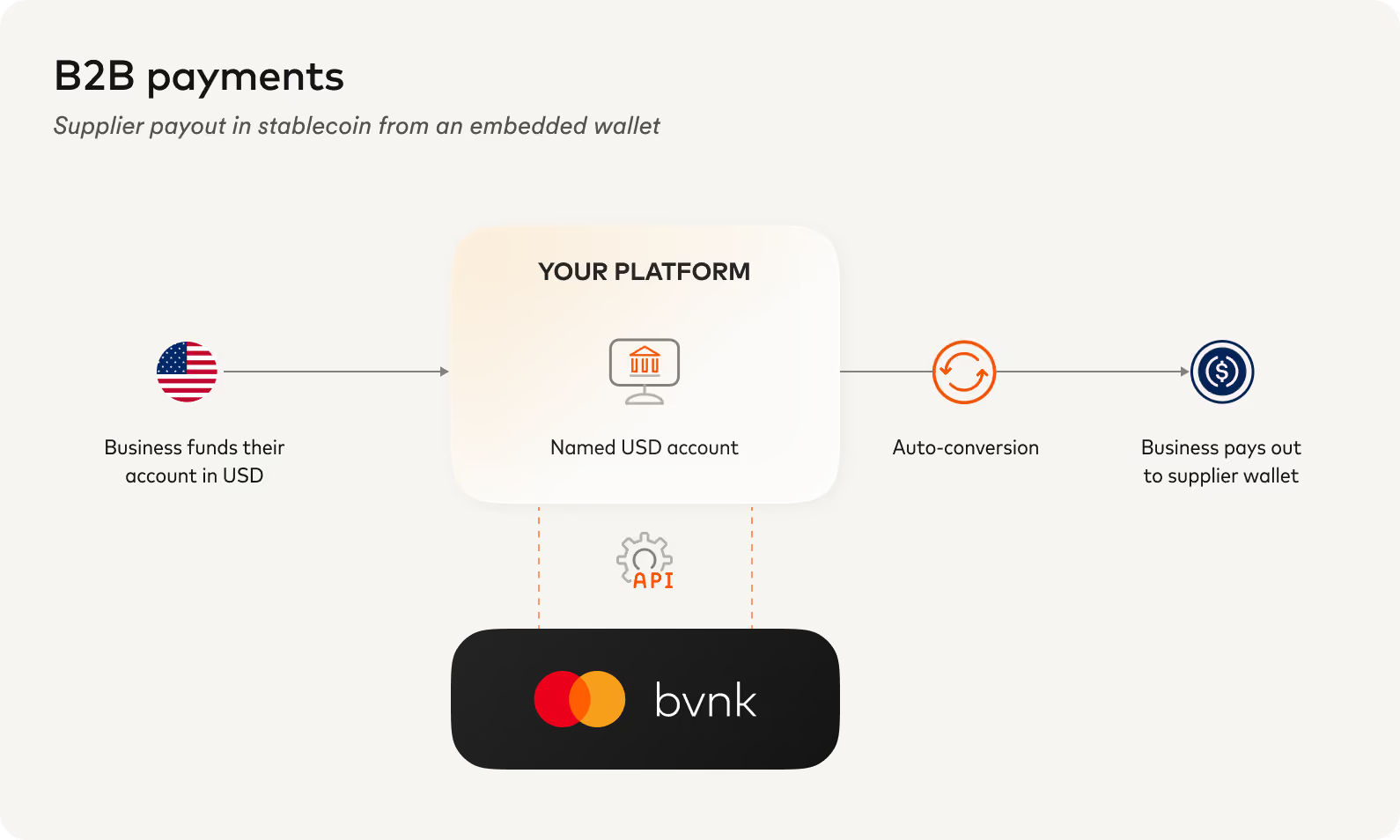
Example fund flow: Embedded supplier payout in stablecoins

Challenge:
Corpay serves more than 800,000 clients worldwide, processing over $12 billion in corporate payments and $26 billion in foreign exchange each month across 145+ currencies. At this scale, moving liquidity quickly and reliably across borders is critical – yet traditional banking infrastructure operates on fixed hours and fixed rails, creating delays and inefficiencies. Corpay customers need flexible payment options that work beyond banking hours, with better capital efficiency and faster settlement for global transactions.
Solution:
Corpay partnered with BVNK to integrate stablecoin wallets and settlement capabilities into its platform. The integration enables Corpay's customers to hold stablecoin balances alongside fiat balances, with embedded wallets for sending, receiving, storing, and converting stablecoins directly within the platform. This gives customers access to always-on payment rails that operate 24/7.
Corpay is also integrating stablecoin settlement into its own treasury operations. This reduces reliance on pre-funded accounts, improves capital efficiency, and enables faster movement of funds across its global footprint outside of its proprietary network.
Result:
- 24/7 settlement capability enabling customers to move funds beyond traditional banking hours.
- Improved capital efficiency for Corpay through reduced pre-funding requirements and faster liquidity movement.
- Faster cross-border transactions leveraging stabelcoins for settlement in minutes.
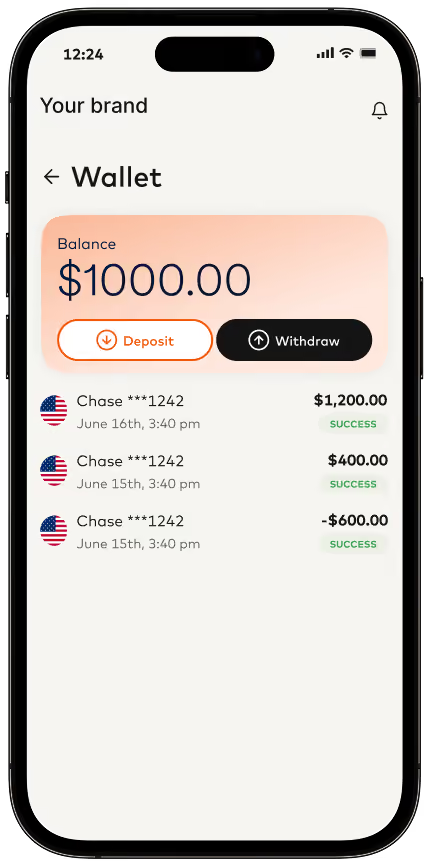
Demo: B2B payments
Create an instant personalized demo to see how stablecoin wallets could work in your platform.

Salary and gig payouts
International workers, sellers and creators can receive wages or earnings in stablecoins using embedded wallets.
How it works
A contractor wants to receive a salary in stablecoins.
- Fund: You fund a named wallet in USD in your platform (powered by BVNK).
- Initiate: Contractor selects to withdraw salary in stablecoins. They create a stablecoin wallet and select stablecoins as payout method. They then select the amount and confirm withdrawal.
- Send: BVNK automatically converts the fiat currency to stablecoins and updates the user’s USD and stablecoin wallet balance, or if user opts to receive to an external wallet – BVNK processes payment.
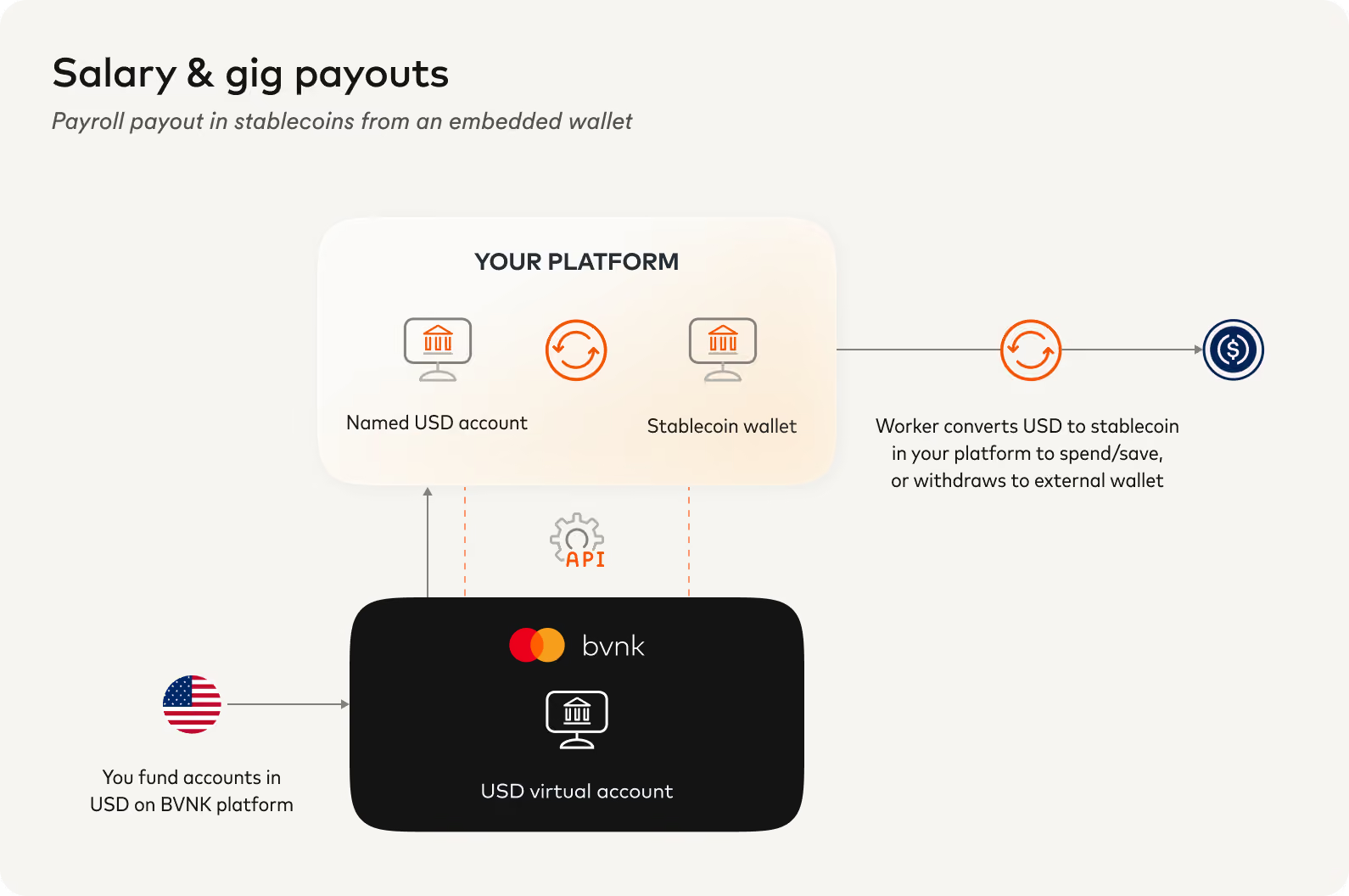
Example fund flow: Embedded B2C payout in stablecoins


Challenge:
The global freelance workforce is thriving, growing 15x faster than traditional jobs, while the global gig economy market is expected to triple in size by 2032. And with the rise of global HR services and employer of record platforms like Deel – it's easier than ever for businesses to hire and manage freelance talent globally.
Despite this, paying workers overseas remains a challenge. Today's cross-border payment systems can leave workers waiting days for money – only to lose out to unfavourable currency conversions at the last mile. Employers meanwhile can be held back by tied-up capital and exposed to foreign exchange risk.
Solution:In Spring 2024, Deel teamed up with BVNK to enable embedded stablecoin payouts to global contractors. With BVNK's infrastructure, workers employed via Deel can fast-track wage payments with dollar-backed stablecoins like USDC, receiving them in minutes not days.
With BVNK's auto-conversion capabilities, there's no need for the Deel team to handle crypto. They fund their BVNK account in USD, EUR or GBP, and funds are converted automatically on payout. With this solution in place, Deel can ensure a seamless service for contractors, while remaining at the forefront of global payments innovation.
Following strong contractor adoption, Deel expanded the partnership in 2026 to stablecoin salary payouts for full-time employee. Employees opt in once, stablecoins land on payday, while companies can also fund payroll accounts in stablecoins directly.
Result:
- Settlement reduced from 3-5 days to near-instant.
- 10,000+ contractors in 100+ markets now have opted to be paid in stablecoins.
- Full-time employee stablecoin payroll expanding use case from gig economy to enterprise global payroll.now live,
Demo: Salary and gig payouts
Create an instant personalized demo to see how stablecoin wallets could work in your platform.
P2P remittances
Customers can send international transfers via stablecoins to family and friends – either ending in stablecoins, funding in stablecoins, or using stablecoins to accelerate the middle of a transaction.
How it works:
Your user in the USA wants to send money to a family member in Mexico.
- Sign-up: Your customer opens a USDC digital dollar wallet in your app.
- Fund: You or your customer fund the named wallet in USD in your platform (powered by BVNK). BVNK converts USD to USDC credits your customer’s balance.
- Initiate: Your customer adds beneficiary details and sets up/confirms stablecoin payout from your platform.
- Send: BVNK sends USDC to beneficiary wallet.
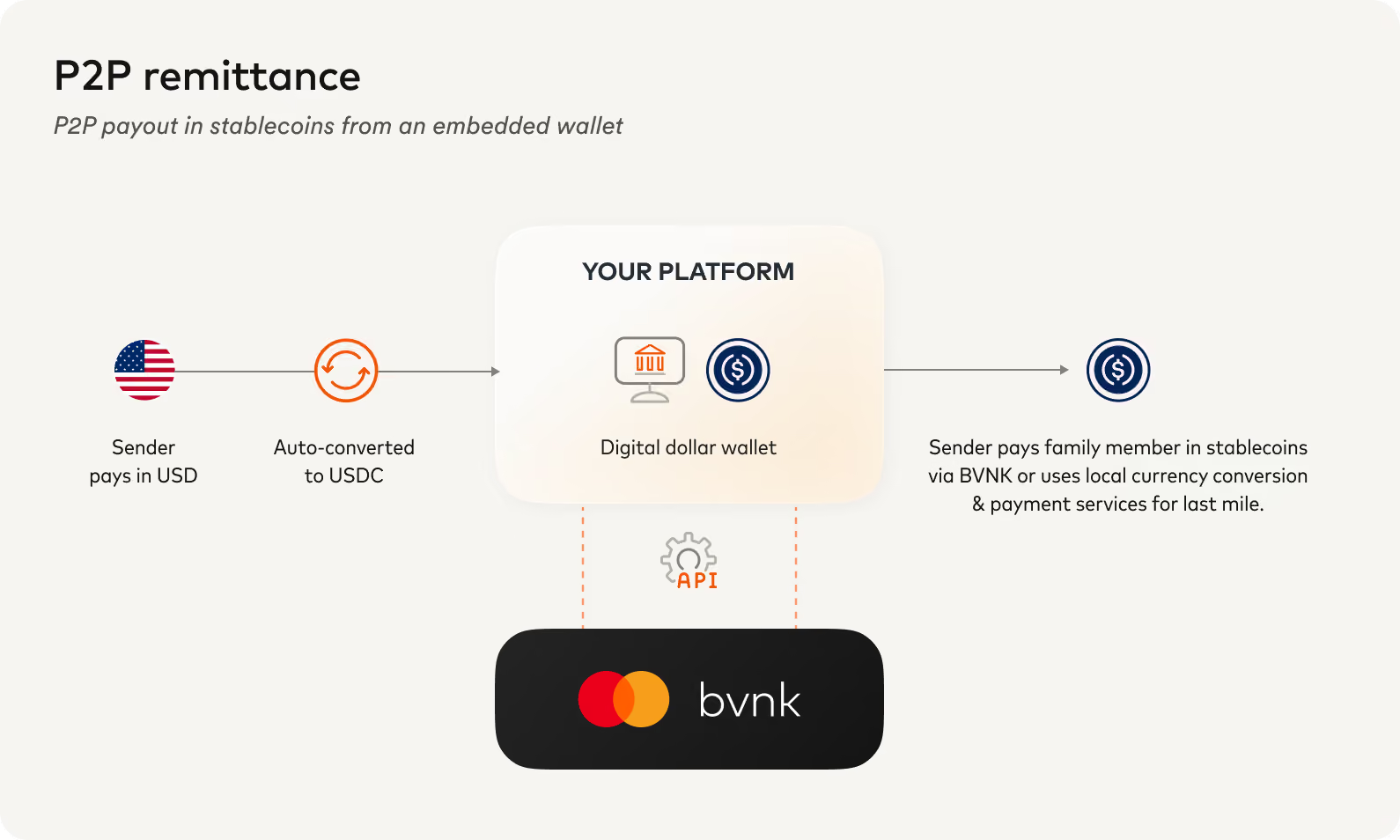
Example fund flow: Embedded P2P payout.
Global digital dollar accounts
Customers can hold a global dollar account backed by stablecoins for saving, spending, earning, or making payments.
How it works:
Your user pays in USD to a digital dollar account for global spending, saving and earning.
- Sign-up: Your customer opens a USDC digital dollar wallet in your app, powered by BVNK.
- Fund: Your deposits USD into the wallet. BVNK converts USD to USDC credits your customer’s balance.
- Send: Your customer sends USDC to a beneficiary wallet.
- Earn: Your customer can hold stablecoins in their wallet and earn rewards on idle funds.
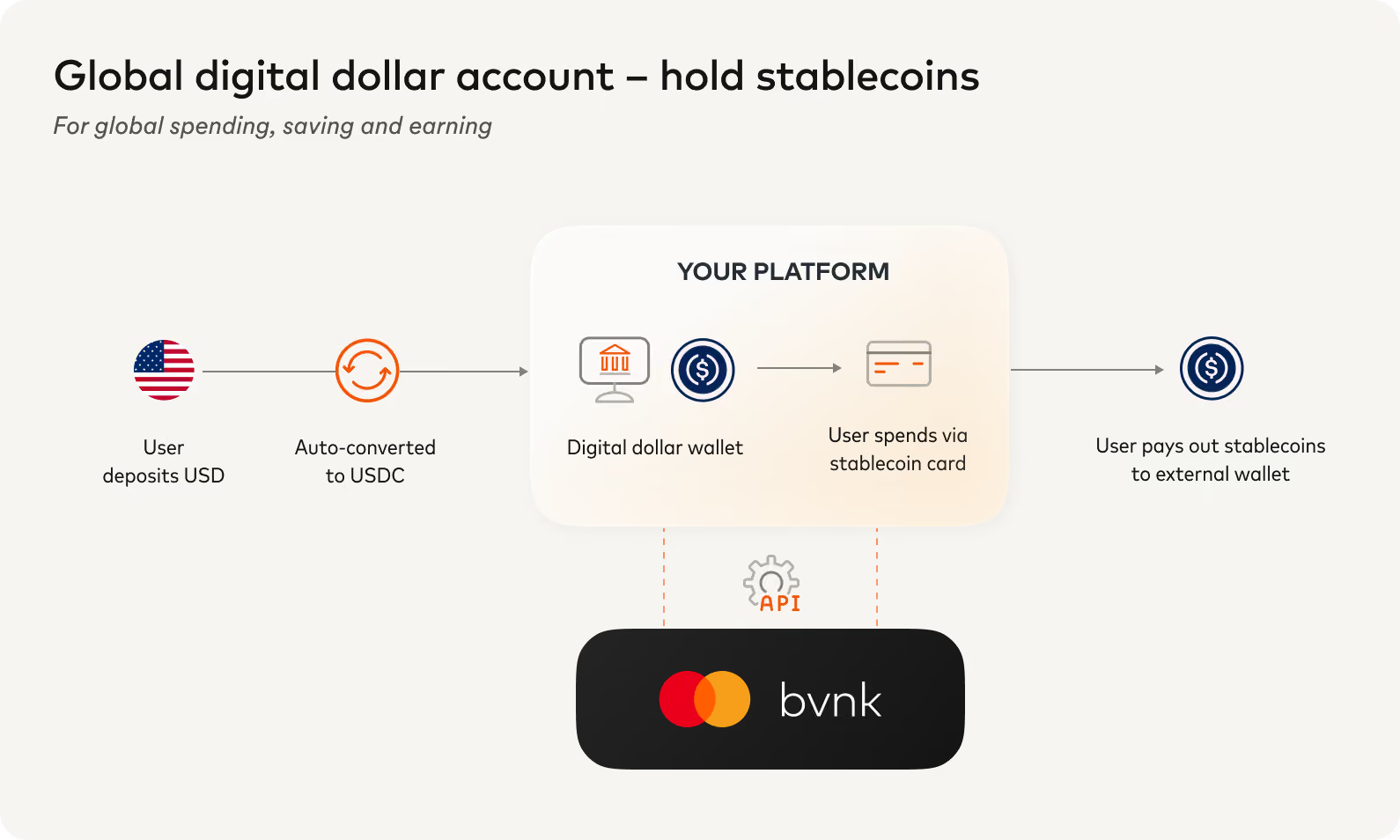
Example fund flow: User pays in USD to a digital dollar account for global spending, saving and earning.
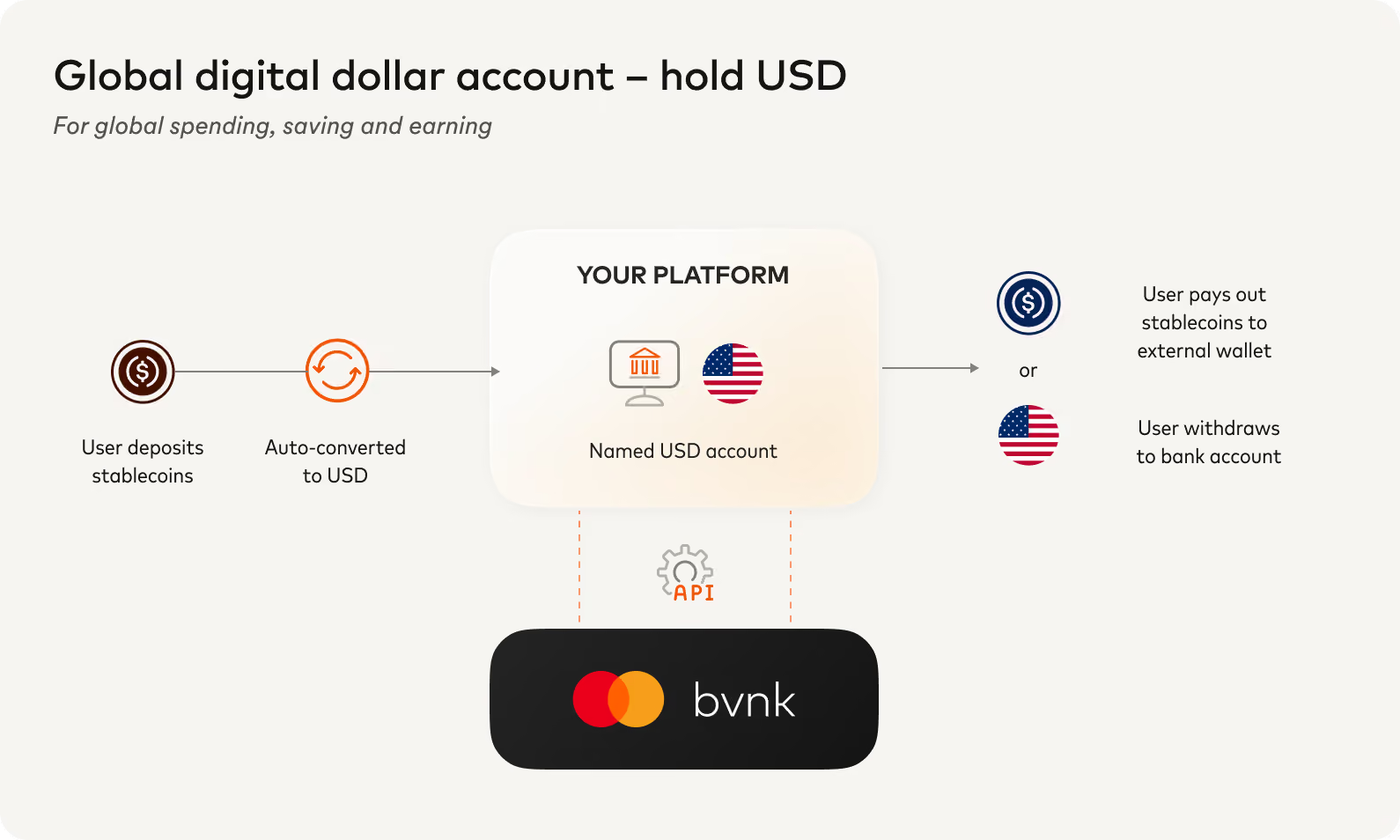
Example fund flow: User pays in stablecoins to a USD account for global spending, saving and earning.

Challenge:
Remote workers in emerging markets like Latin America and India face significant obstacles when receiving payments from US employers including settlmeent delays of 3-5 day, unfavorable currency conversion rates and limited banking options in local markets. Utoppia customers want access to US dollars, but also need to spend and move those funds globally without friction.
Solution:
Utoppia, a US-based fintech founded to give remote workers in emerging markets access to US dollar banking services, integrated BVNK's stablecoin infrastructure to solve this problem. Utoppia users receive US dollar payments from employers into their Utoppia USD bank account.
From their USD balance, they can choose to convert to stablecoins and send payouts to any wallet globally, powered by BVNK. BVNK auto-converts USD to stablecoins and settles in minutes. This enables remote professionals, like a designer in Argentina working for US companies, to maintain their earnings in dollars while accessing and spending those funds globally.
Result:
- Near instant settlements: stablecoin payouts in seconds, not days.
- Stablecoin capabilities projected to grow Utoppia's annual revenue more than 40%.
- 50% of Utoppia's deposits projected to be in stablercoins within the year.

Demo: Global digital dollar accounts
Create an instant personalized demo, to see how your customers can create accounts and send or receive payments in stablecoins in your platform.
3. Adoção global
Dados fundamentais para ajudar você a entender onde a demanda por serviços de pagamento com stablecoins é maior.
Posse de criptoativos

Posse de stablecoins
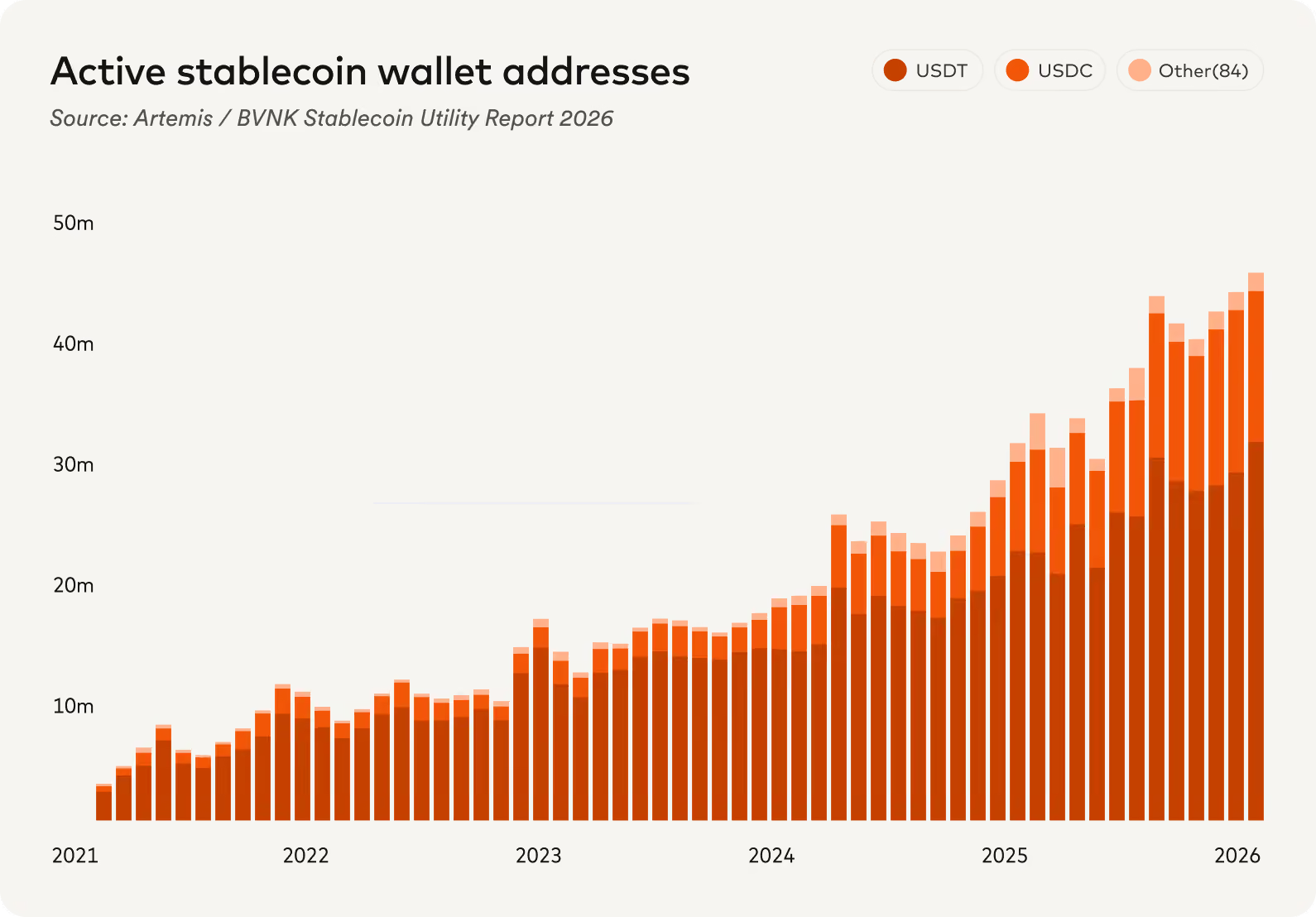
O número de endereços de carteira ativos de stablecoins aumentou 1300% em 5 anos.
Stablecoins e redes mais populares
Stablecoin user demographics
Globally, stablecoin owners skews young, entrepreneurial. In BVNK’s 2026 Stablecoin utility report, which surveyed around 5000 users in 15 countries, we found:
- More than half of stablecoin owners and prospective acquirers are 18-34.
- 6 in 10 current/recent owners are men, but in middle- and lower-income economies, the gender split is more balanced.
- Those earning through business, entrepreneurship or active trading are more likely to own or show interest in stablecoins.
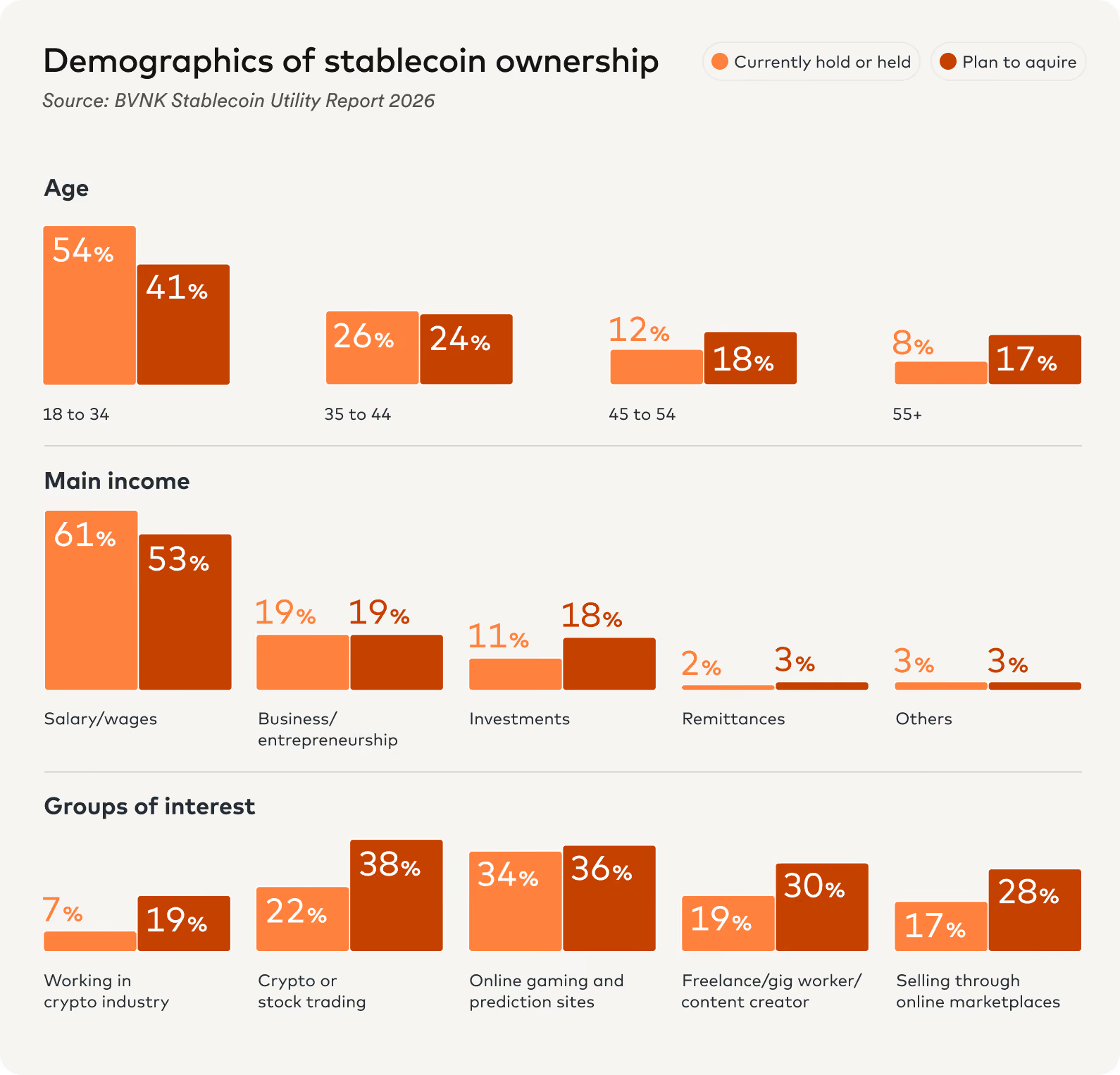
Source: BVNK Stablecoin Utility Report 2026.
Where should you launch stablecoin wallets?
High opportunity markets show strong stablecoin adoption and fintech maturity and are well supported by infrastructure providers.
Medium opportunity markets have established but slower-growing adoption. Note that some markets are likely to be prohibited by your stablecoin infrastructure partner due to regulatory or risk restrictions. For a guide to high and medium opportunity markets, see below.
Note: This is based on BVNK’s assessment of both market adoption signals and fintech infrastructure maturity. It is provided for informational purposes only. It aims to give an indication of where stablecoin adoption is significant and where your services might gain traction. Market demand and availability of wallet infrastructure will also depend on your use case: speak to a BVNK expert for more guidance.
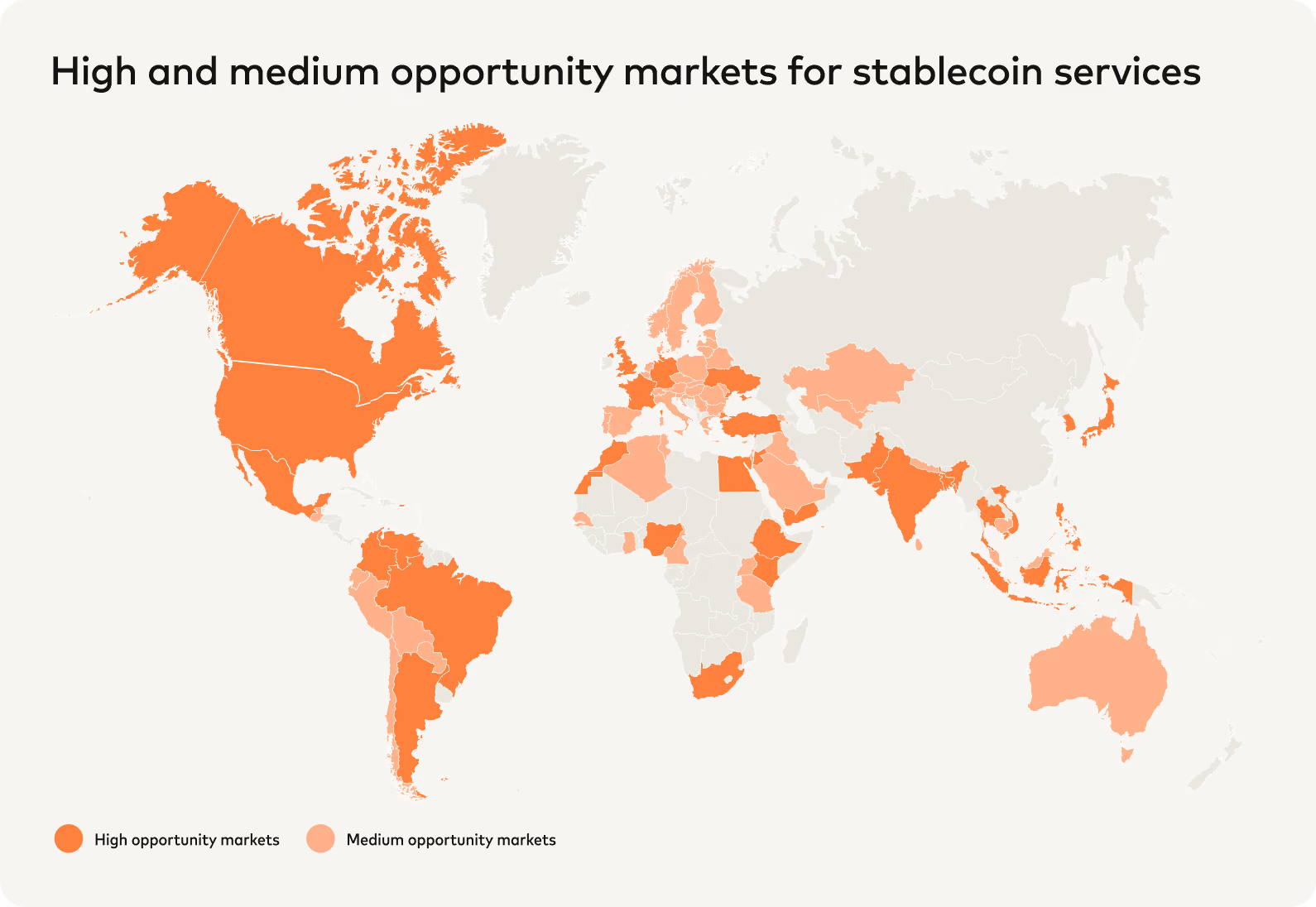
Markets with strong stablecoin adoption and fintech maturity.
High opportunity markets
Argentina, Bangladesh, Brazil, Canada, Colombia, Egypt, Ethiopia, France, Germany, India, Indonesia, Japan, Jordan, Kenya, Mexico, Morocco, Nigeria, Pakistan, Philippines, South Africa, South Korea, Thailand, Turkey, Ukraine, United Kingdom, United States (all 50 states + DC + Puerto Rico), Venezuela, Vietnam, Yemen.
Medium opportunity markets
Algeria, American Samoa, Armenia, Australia, Austria, Belarus, Belgium, Bermuda, Bolivia, British Virgin Islands, Bulgaria, Cambodia, Cameroon, Cayman Islands, Chile, Croatia, Cyprus, Czech Republic, Denmark, Ecuador, Estonia, Falkland Islands, Finland, French, Polynesia, Georgia, Ghana, Gibraltar, Greece, Guam, Guatemala, Guernsey, Hong Kong, Hungary, Iraq, Isle of Man, Israel, Italy, Jersey, Kazakhstan, Kyrgyzstan, Latvia, Liechtenstein, Lithuania, Luxembourg, Malaysia ,Malta, Mann Island, Mariana Islands, Montserrat, Moldova, Nepal, Netherlands, New Caledonia, Norway, Paraguay, Peru, Poland ,Portugal, Romania, Saudi Arabia, Senegal, Serbia, Singapore, Slovakia, Slovenia, Spain, Sri Lanka, Sweden, Switzerland, Tanzania, Tunisia, Uganda, United Arab Emirates, Uzbekistan, Virgin Islands, U.S.
4. How wallets work: setup and responsibilities
Embedded stablecoin wallets enable businesses to offer stablecoin services to their customers under their own brand, in their own platform.
Who does what in an embedded model?
In an embedded model, your partner uses their digital asset license to deliver stablecoin services to your customers. They're responsible for processing payments, AML screening, KYC/B, and meeting regulatory standards set by their regulator.
Below we explain how this works operationally and legally (including compliance responsibilities, custody and onboarding process), using BVNK as the example provider.
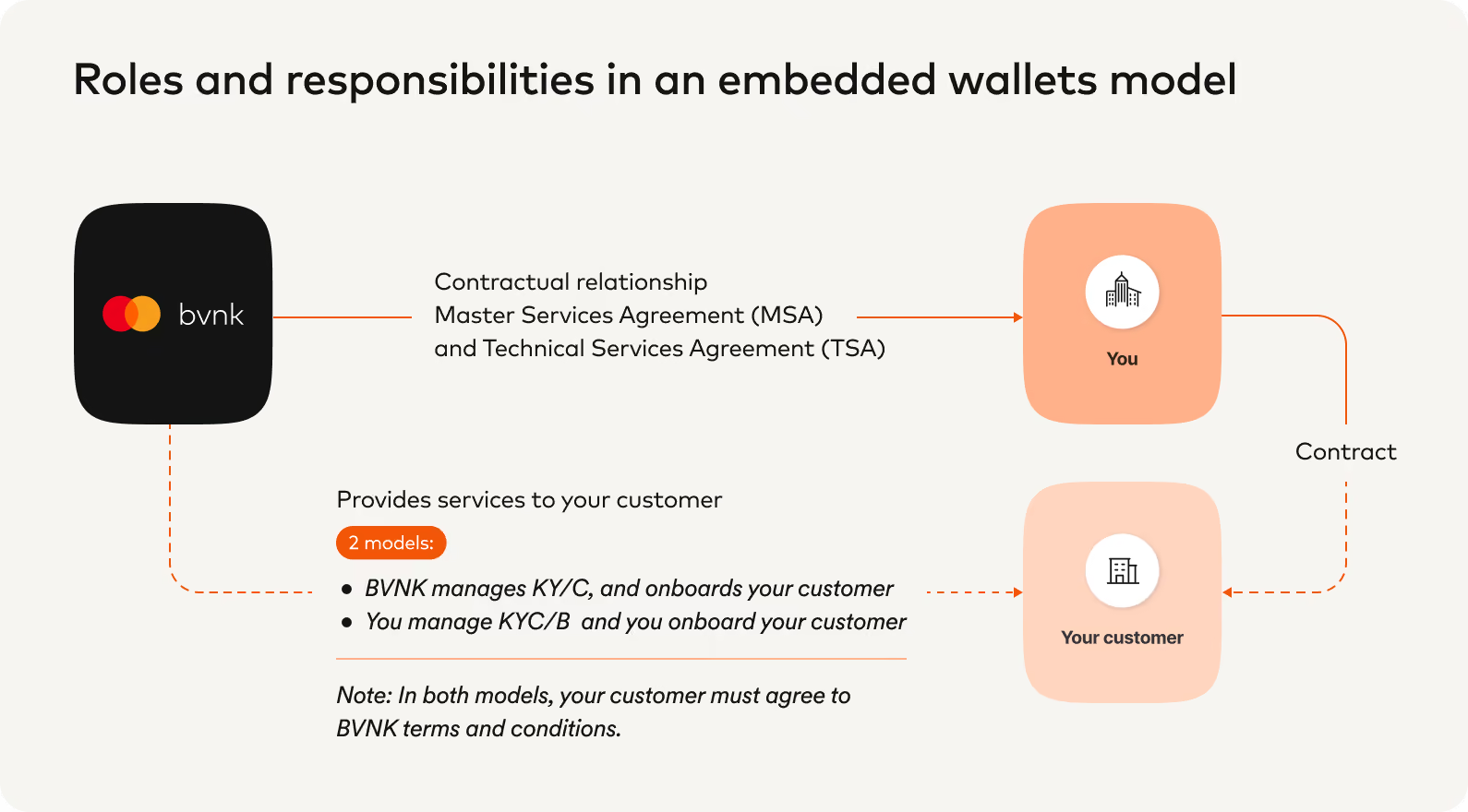
Example of roles and responsibilities in an embedded model
Compliance FAQs
Does my business need to handle stablecoins?
There’s no need to handle stablecoins yourself if you prefer not to. In an embedded model, your provider delivers stablecoin services directly to your users through your platform. You leverage your provider’s digital asset licenses and they custody the stablecoins on behalf of your users.
How does custody of digital assets work?
In a custodial model, your customer’s stablecoin wallet is provided by your stablecoin partner and that provider securely holds and manages funds, handling compliance, (eg KYC and AML transaction monitoring) security, and operations.
In a self custody model, your user can create their own self-custodial stablecoin wallet in your app. They then control their own funds and private keys, and are responsible for their own funds. Your stablecoin partner may offer advanced recovery options for self-custodial wallets – for example, email-based recovery instead of relying solely on seed phrases.
It can be helpful to offer both custodial and self custodial options to your users – depending on local regulations, and user preferences. However it’s worth noting that self-custody wallets may be limited in their connectivity, since providers may not be able to offer regulated services such as conversion, through self custodial wallets.
How are funds safeguarded?
If your provider is keeping custody of digital assets on your behalf (ie they provide custodial wallets to your users), they should follow strict segregation practices to keep your digital assets safe.
Ensure your provider maintains a strict distinction between the treatment of fiat (traditional currency eg e-money ) and digital assets (stablecoins/crypto) to ensure compliance with relevant global regulatory standards. For example, under European payments and digital asset regulations, ‘Safeguarding’ refers to the regulation protection framework for e-money, while ‘Safekeeping’ is the name of the regulatory framework for digital assets in stablecoins. Your providers’ safeguarding and safekeeping practices should be subject to regular internal audits and external regulatory reporting to authorities.
For crypto assets, they must also maintain 1:1 asset backing and a full-reserve model (meaning they don’t engage in fractional banking, lending, or rehypothecation). Stablecoin payment providers should also keep an internal ledger – a real-time internal record of each client’s holdings and carry out daily reconciliation to cross-reference internal records with blockchain entries and bank statements to ensure our assets are always identifiable and 100% accurate.
Who manages compliance and AML?
Under an embedded model, your partner is using their digital asset license to deliver stablecoin services to your customers – they are responsible for processing payments, for AML screening, KYC/B, custody and meeting the standards set out by their digital asset licence.
Ensure your provider monitors transactions in real time using a combination of blockchain screening, sanctions screening, geolocation controls, and transaction monitoring rules. These controls are used to detect suspicious activity, identify exposure to prohibited or high-risk counterparties, and support AML investigation where needed.
At times, your provider may need to escalate or investigate transactions to meet regulatory requirements. Ask your provider about their process for this. For example, BVNK’s framework supports manual review and specialist escalation. This includes requests for information, deeper investigations, suspicious activity reporting where required, sanctions assessments, and local compliance oversight.
Who handles Travel Rule compliance?
The Crypto Travel Rule is a key piece of AML regulation for digital assets. It requires certain identifying information about the sender and recipient of digital asset transfers to be shared between cryptoasset service providers. It is now in force in many regions across the world. In an embedded model, your provider is responsible for Travel Rule compliance. This means they must collect and validate relevant sender and beneficiary information for applicable transactions, while preventing non-compliant transfers from being processed, in line with jurisdictional requirements. These requirements will impact certain parts of your user experience and operations – be sure to ask your provider what this means for you.
Who is responsible for customer support?
In most cases, you are still responsible for customer support and most businesses prefer to keep full control of direct communications with their own customers. It’s advisable to put in place SLAs with your provider to ensure their technical and support teams are on hand to quickly respond to and work with your support team, to resolve any issues that your customers face.
5. Product capabilities
A stablecoin wallet enables you or your users to store, send, receive and convert stablecoins. Additional products like cards and rewards can be layered on top.
Core functionality
Multi-currency balances
Embedded stablecoin wallets can hold balances in stablecoins or fiat currencies (eg USD, EUR, GBP). Regardless of which you hold, the wallet connects to both stablecoin and fiat payment rails. When payment currency differs from balance currency, auto-conversion typically occurs at the point of transaction.
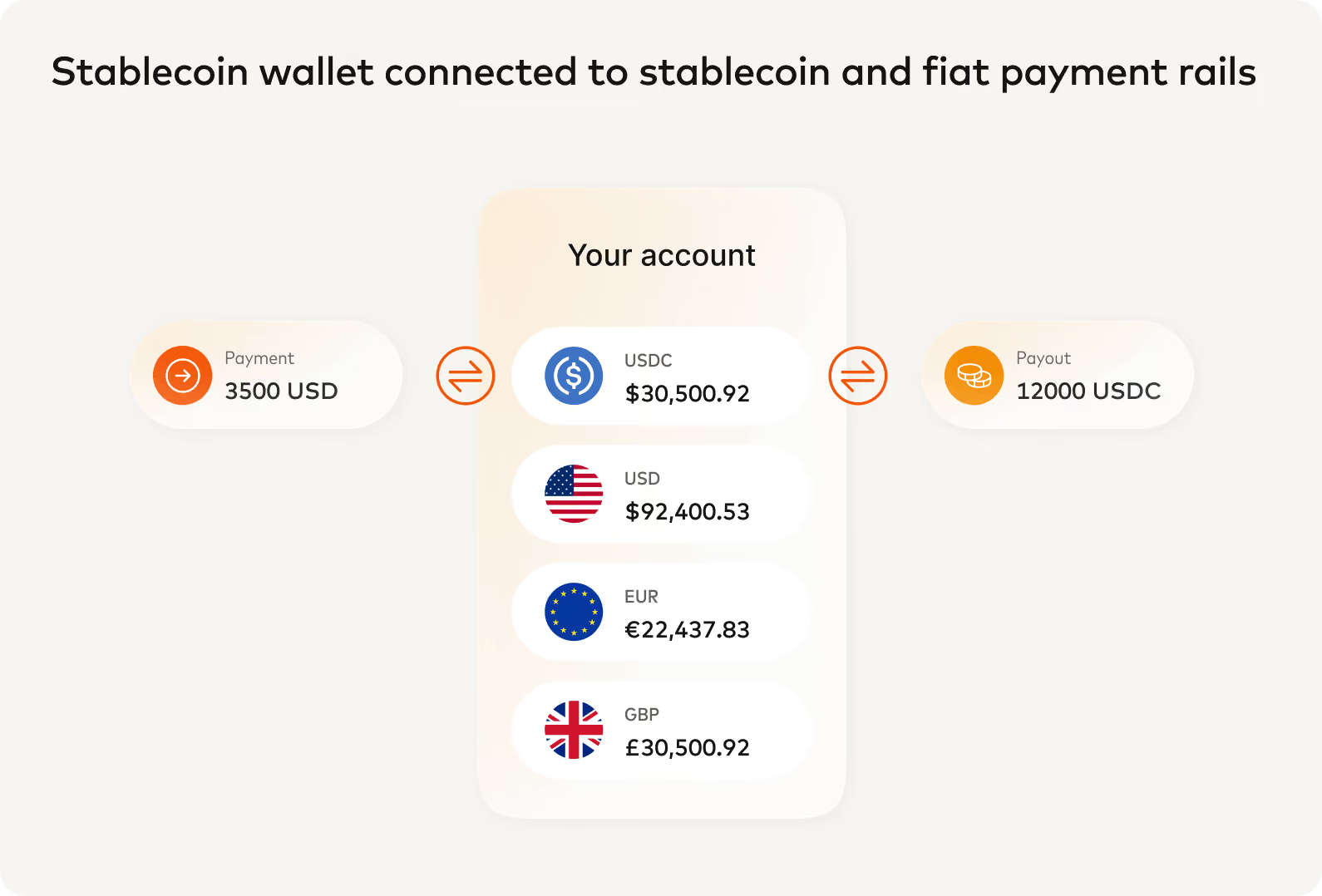
Hold stablecoins in a wallet, pay in/out in stablecoins or fiat.
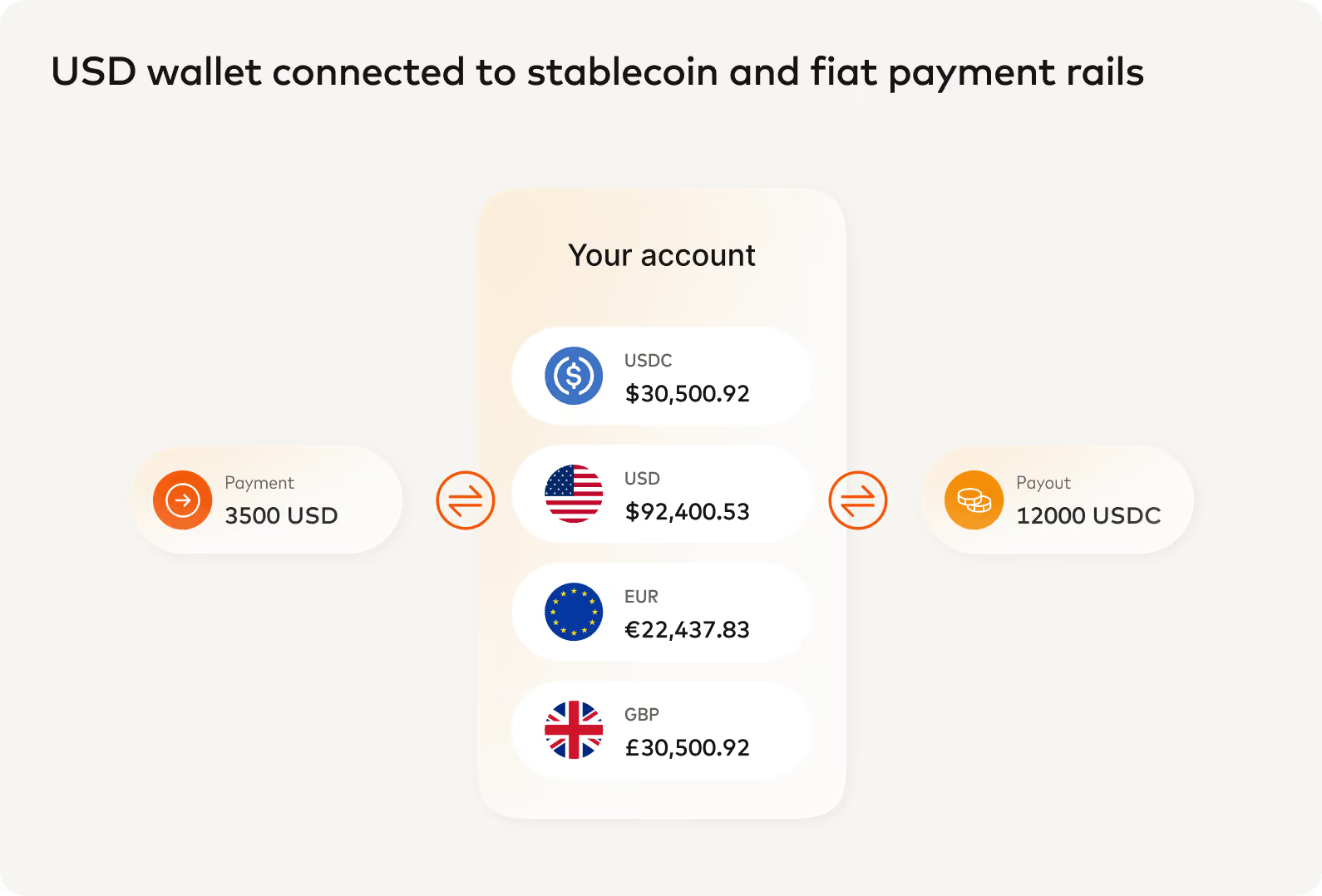
Hold stablecoins in a wallet, pay in/out in stablecoins or fiat.
Interoperable with fiat
Stablecoin wallets are typically connected to fiat payment rails like Swift, SEPA, ACH and Fedwire, enabling users to deposit and withdraw using relevant local and international payment rails.
Auto-conversion
Stablecoin wallets can support automatic conversion into your preferred settlement currency, whether stablecoin or fiat, at the point of receipt or payout. This is a technical capability to consider when evaluating infrastructure.
Supports multiple networks and tokens (no lock-in)
Different blockchains support different payment types – for example, Solana for micropayments. Users in different regions may prefer different stablecoins (USDT, USDC, PYUSD). Embedded wallets can support multiple networks (Binance Smartchain, Solana, Ethereum, Tron, Polygon) and multiple stablecoins.
Named accounts and payments
Under the hood, some embedded fiat wallets may use an omnibus or pooled account in your name. To make reconciliation easier, look for a provider that can issue segregated named virtual accounts in your customers’ names, for the currencies (and payment rails) you need.
Onboarding and support
User onboarding
The time it takes to onboard your users to stablecoin services has historically been a bottleneck across the industry, but this is changing, unlocking a step-change in time to launch. Eligible individuals can onboard to BVNK in minutes, and we’ve accelerated onboarding for businesses by 75% since 2025.
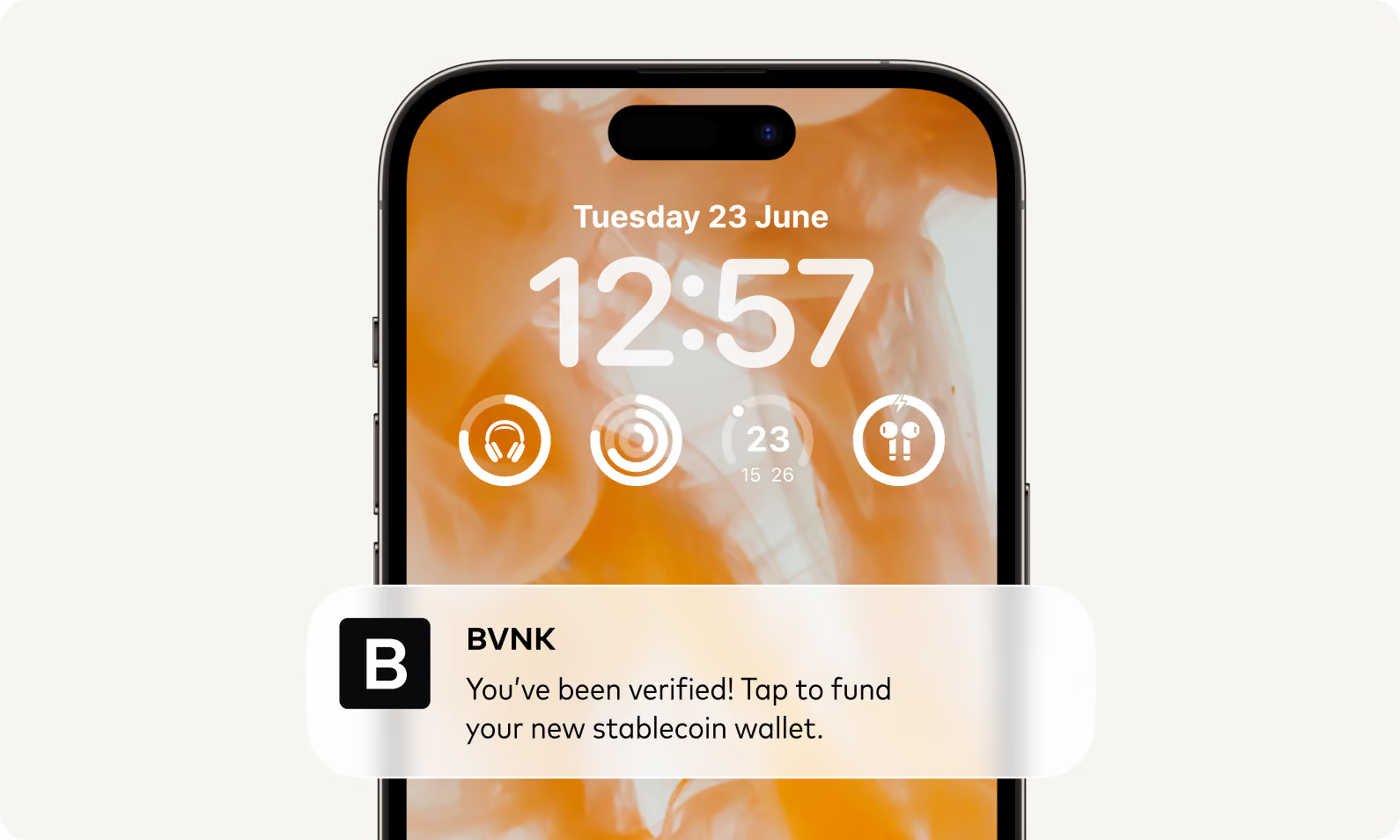
Customer onboarding completed and account verified.
Launch support
Your embedded stablecoin partner should support you with:
- Go to market compliance:sharing real world examples on market adoption and use cases, and reviewing your user experience and marketing for adherence to relevant financial regulations.
- Team training:Ensuring your team staff understand the service and can handle stablecoin-specific questions from users if needed.
- Customer communication:providing examples of how to introduce stablecoin wallet features and educate customers.
- Monitoring adoption:reviewing usage and incentivization options for your users.
Ongoing customer support
It’s important you can resolve any issues quickly for your users, and that your provider enables you to deliver a high level of service. While your provider may not deal directly with your users, ensure you have SLAs in place with them for customer support. For example, BVNK’s average response time on support tickets is 3 minutes, with 24/7 support in place.
Value added services
Stablecoin cards
Users get a card linked to their stablecoin balance and can spend anywhere cards are accepted. For example, a remittance app user with an embedded stablecoin wallet sees an option to "Get a card" - they are issued a card by accepting some additional terms and in most cases, no additional information required. The user can view their card number, set/change pin within their app. They can add their card to Apple / Google pay. When they transact with this card, they see transactions pending/completed/ declined with merchant name, USD and local currency for the expense or charge.
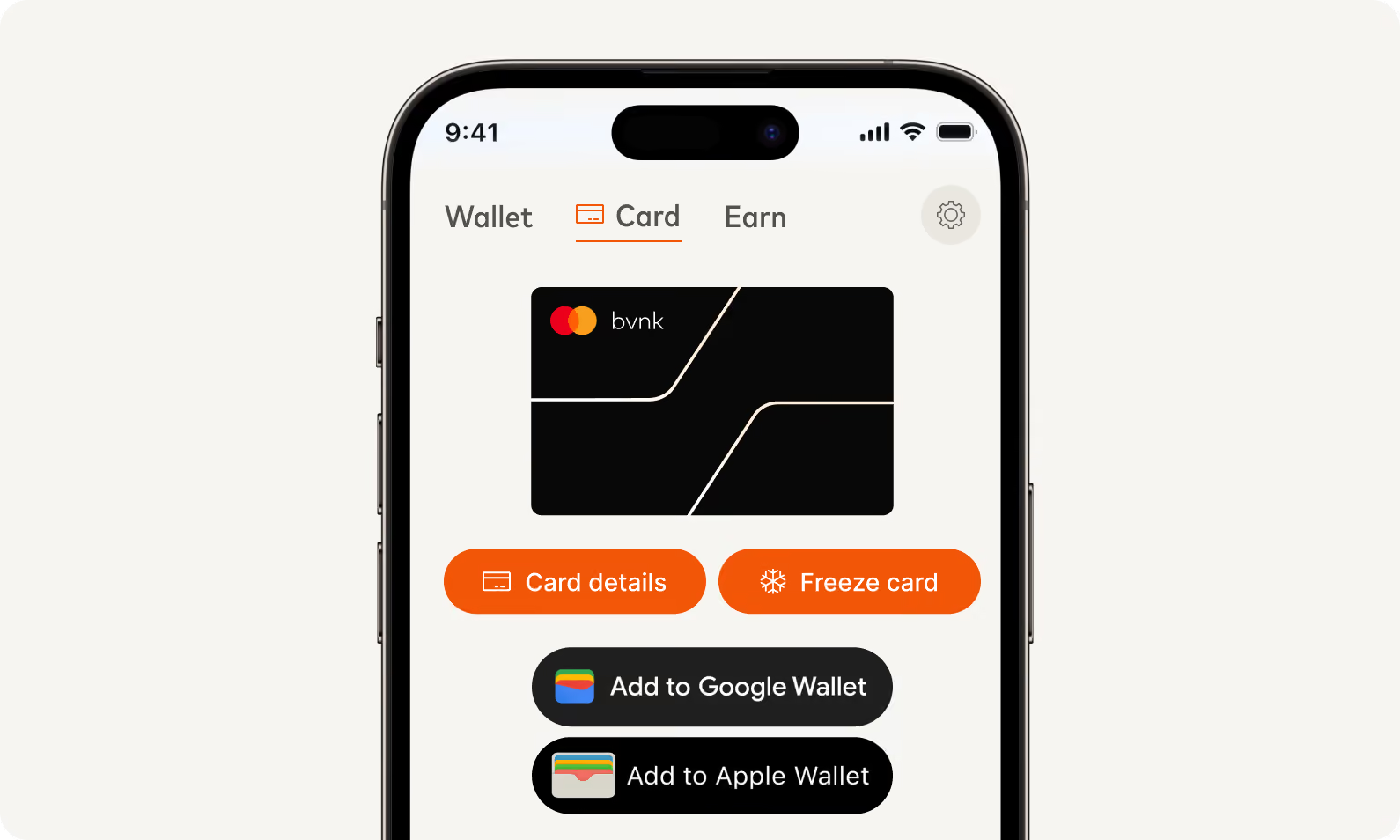
User adding a stablecoin cards to their Apple wallet.
Rewards
If your wallets provider has a rewards scheme in place, your users can earn on their stablecoin balances automatically, without locking up funds.
6. What to expect from wallets pricing
A guide to provider fees
The following are typical examples of fees you may incur with your stablecoin infrastructure partner.
Note: to discuss custom pricing for your needs, please reach out to the BVNK team.
Eg for a $5000 USDT transfer:Ethereum (ERC-20): ~$1-5Solana: ~$0.00025-0.001TRON (TRC-20):~$1-3 Bitcoin: ~$1-20
Alguns provedores não cobram se o custo for muito baixo. A BVNK, por exemplo, cobra apenas por Ethereum, Bitcoin e Tron.
Nota: os provedores podem não cobrar por depósitos em suas plataformas.
Spreads mais altos podem reduzir a conversão em um pagamento, portanto, encontre um provedor que lhe ofereça flexibilidade sobre a aplicação dessa taxa ou se ela já está incluída nas suas taxas de processamento.
Um guia para precificar seu serviço de stablecoin
Ex: para uma transferência de 5000 USDT:Ethereum (ERC-20): ~US$ 1-5Solana: ~US$ 0,00025-0,001TRON (TRC-20): ~US$ 1-3Bitcoin: ~US$ 1-20
• Sem taxa de carteira durante o onboarding.
• Taxas de rede subsidiadas em redes selecionadas.
• Spreads de conversão reduzidos ou isentos para transações iniciais.
• Taxa mensal de carteira ativa (ex: US$ 1).
• Taxas de rede repassadas aos usuários finais.
• Descontos por volume para clientes maiores.
7. Construindo sua experiência com stablecoins
Seu parceiro de infraestrutura deve orientá-lo no design da experiência do usuário e ajudá-lo a entender como manter a conformidade.
Criando sua experiência de cadastro
Inclua informações essenciais na sua página de cadastro para garantir que seus usuários entendam o serviço ao qual estão aderindo.
Antes de começar, pergunte ao seu provedor: quanto tempo leva a análise e verificação do usuário? Como as solicitações são aprovadas ou rejeitadas? Como você deve comunicar as decisões e o status da solicitação aos usuários?
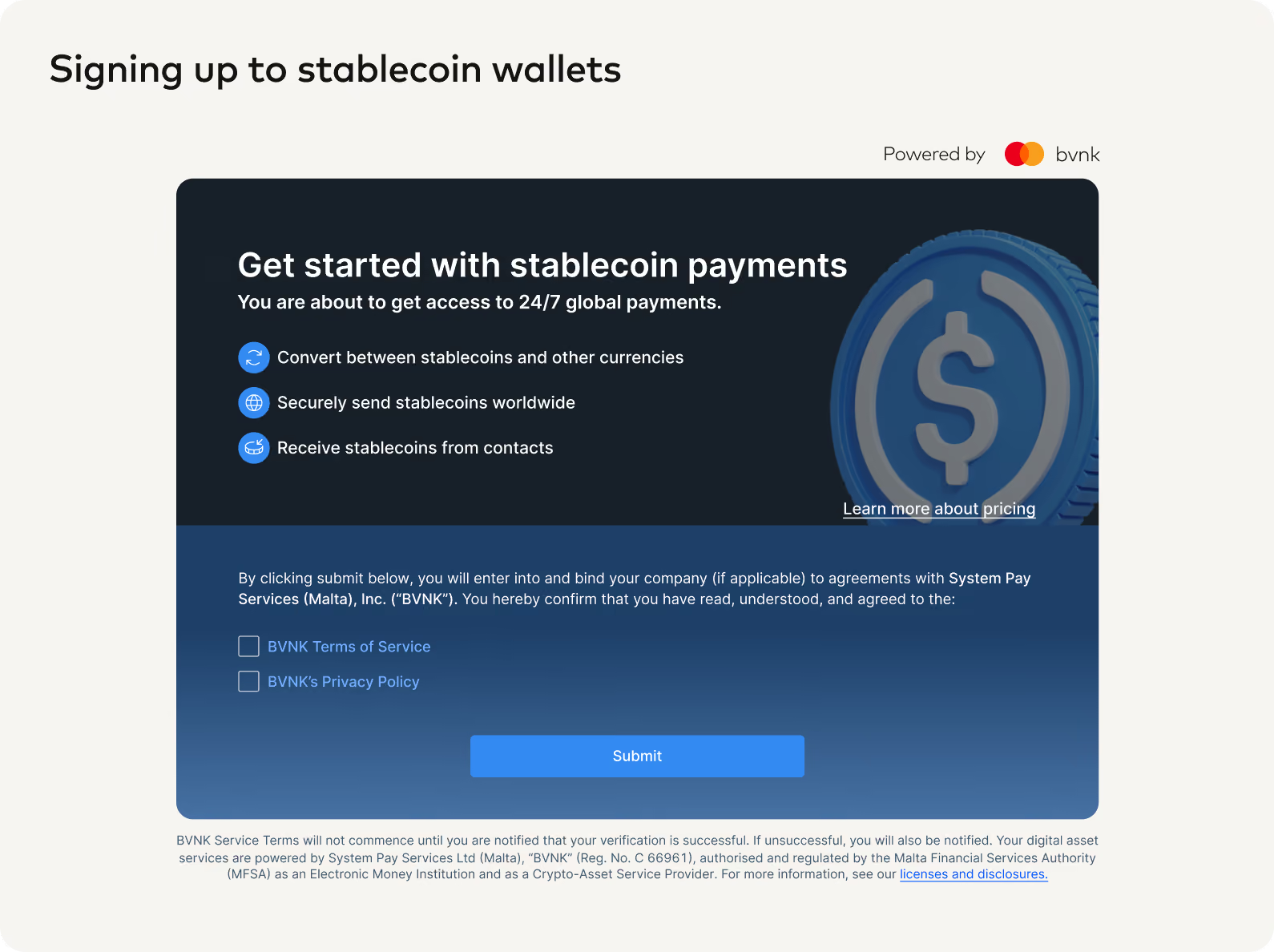
Exemplo de interface: página de cadastro para carteiras de stablecoin.
Quais informações você precisará coletar de seus usuários?
Você precisará fornecer ao seu provedor de carteiras integradas determinadas informações sobre seu usuário para permitir o cadastro. Isso pode variar de acordo com a região e o tipo de cliente (ou seja, pessoa jurídica ou física), mas provavelmente incluirá:
- Nome completo
- Endereço de e-mail
- Cargo (quando aplicável)
- Data e hora em que aceitaram os termos de serviço da BVNK
- Endereço IP ao aceitar os termos de serviço da BVNK
Você pode solicitar que seus usuários forneçam isso ao se cadastrarem no serviço ou enviar os dados ao seu provedor via API.
Saiba mais sobre os documentos e as informações de que você precisará para realizar o onboarding de seus clientes com sucesso em serviços oferecidos pela BVNK:
- Requisitos para o onboarding de clientes pessoa jurídica
- Requisitos para o onboarding de clientes pessoa física
Projetar as jornadas do seu usuário
Peça orientação ao seu provedor sobre os requisitos legais e as melhores práticas de UX para projetar fluxos de usuário essenciais, incluindo:
- Criar e nomear sua primeira carteira
- Adicionar destinatários e remetentes
- Receber stablecoins
- Enviar stablecoins
- Confirmar o pagamento
- Acessar extratos de conta e histórico de transações
Abaixo, compartilhamos alguns exemplos.
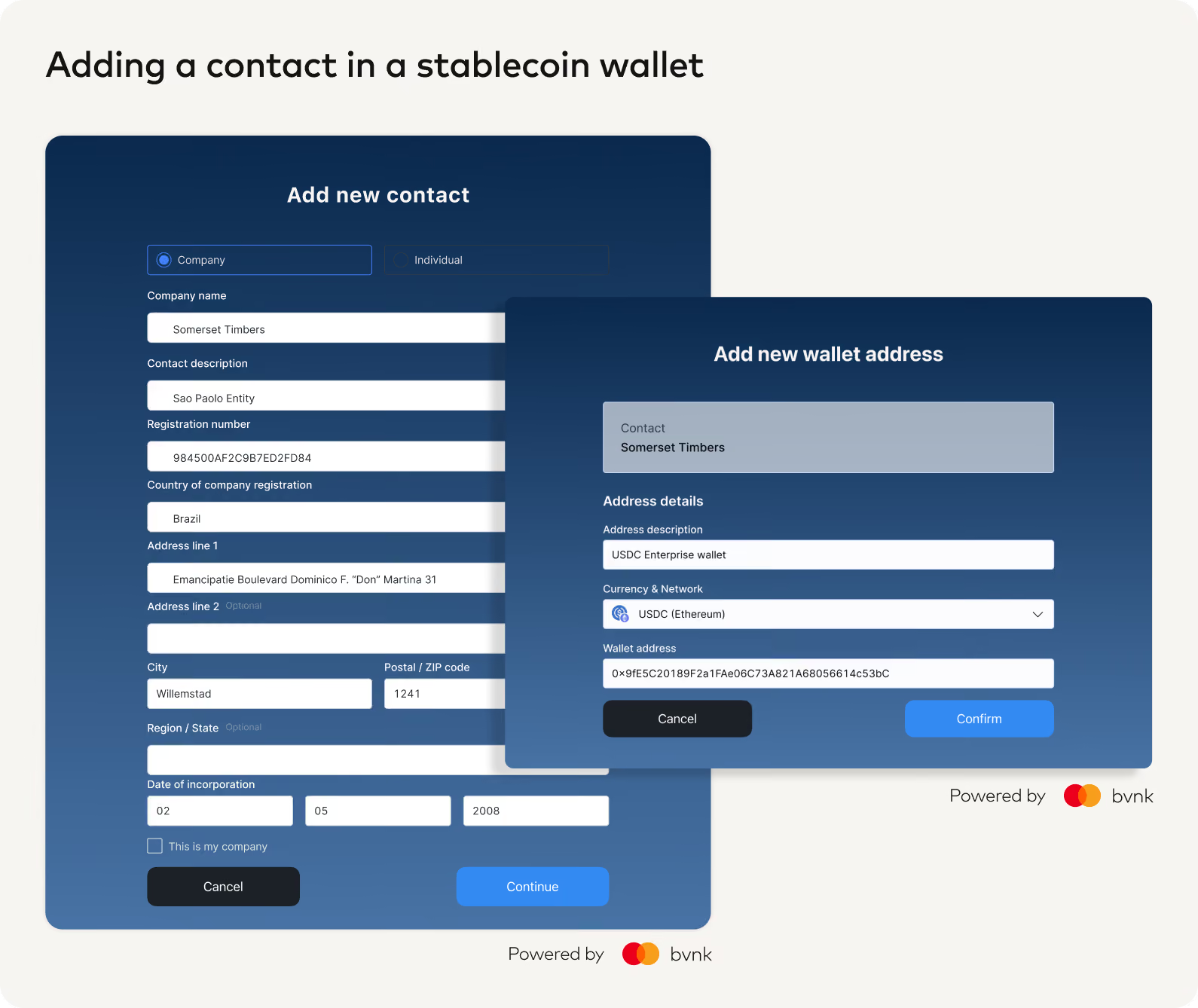
Exemplo do seu cliente adicionando um contato na carteira de stablecoin dele.
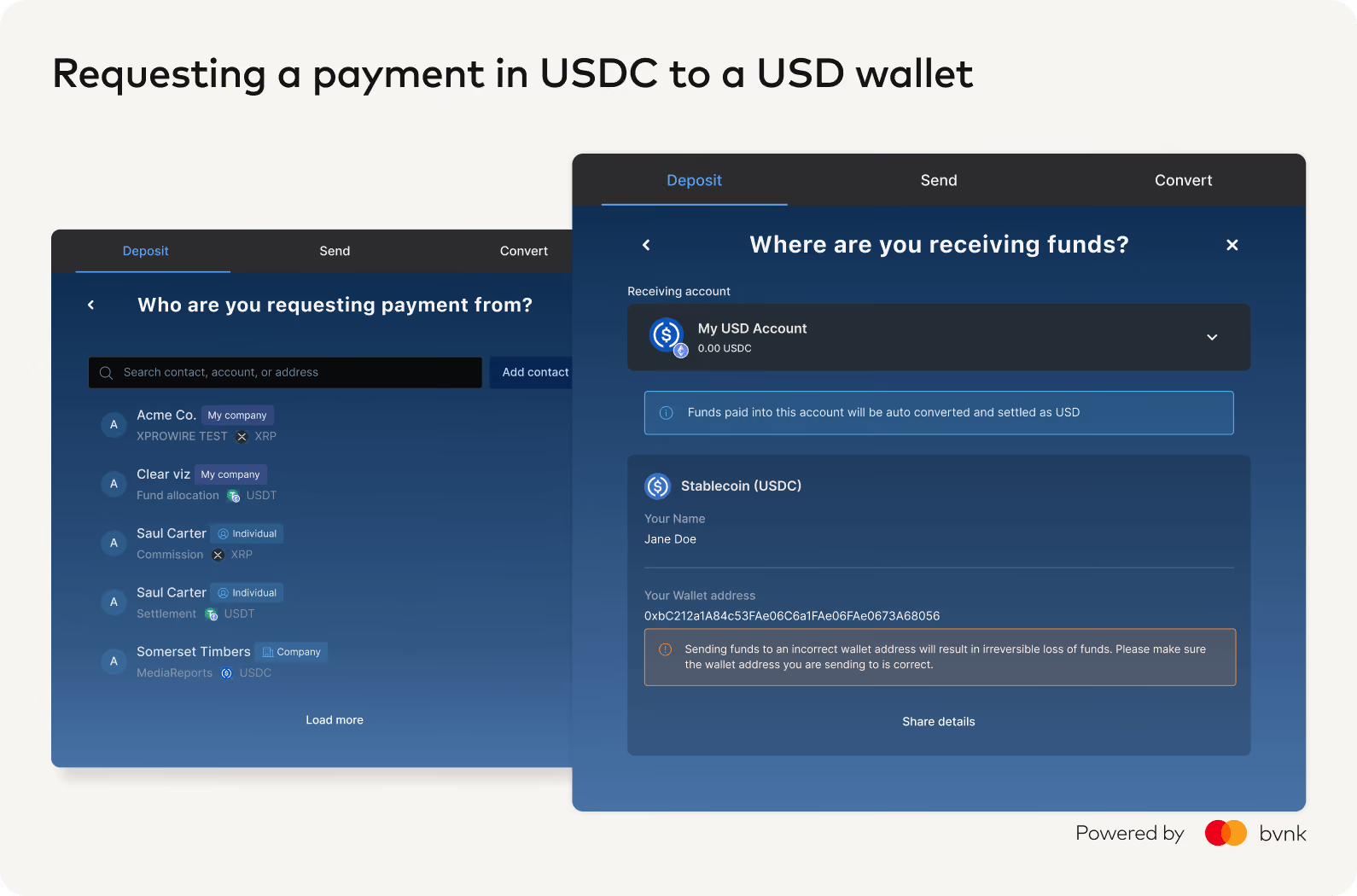
Exemplo do seu cliente solicitando um pagamento de um pagador em USDC para uma carteira em USD (os fundos são convertidos automaticamente para USD).
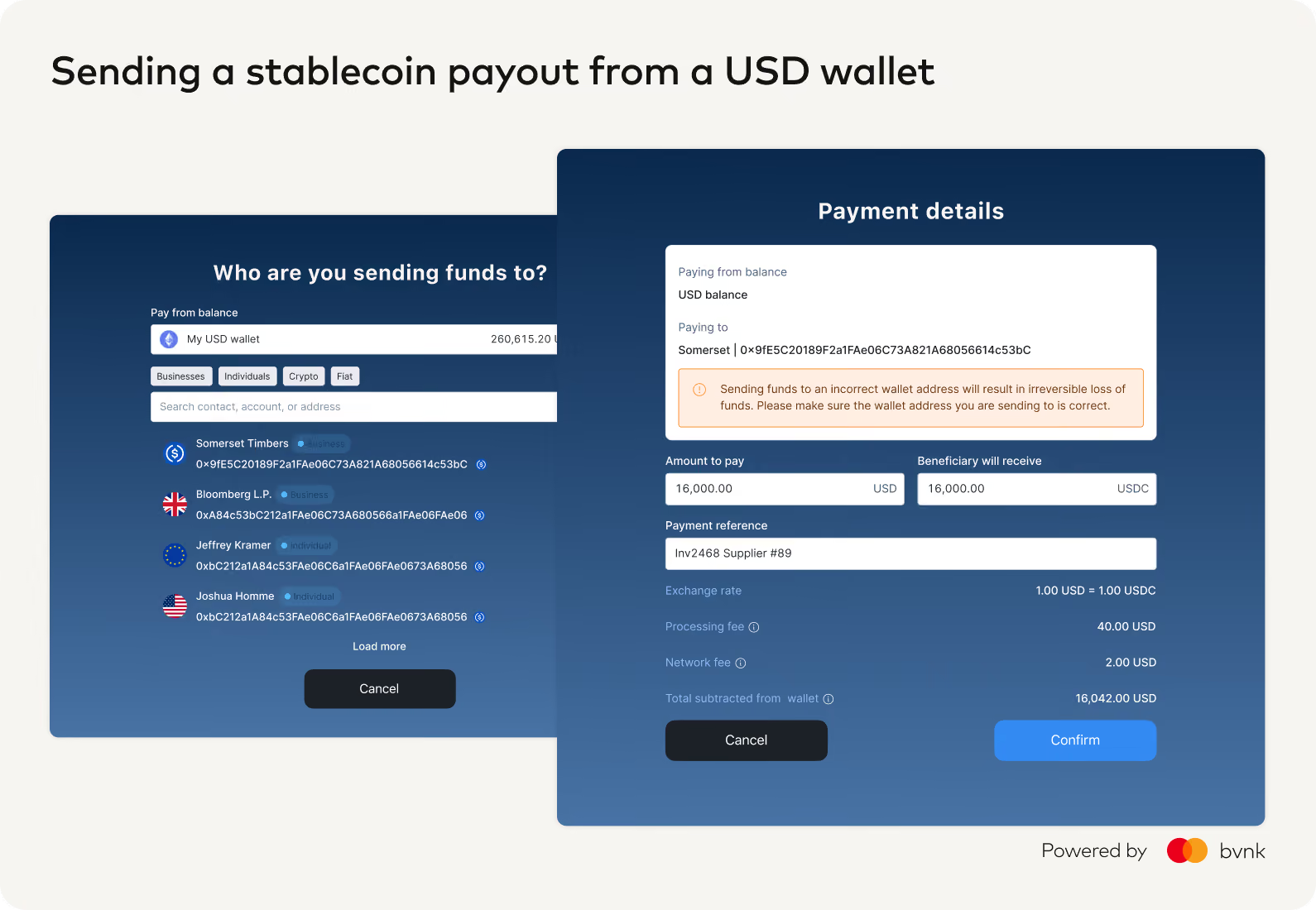
Exemplo do seu cliente enviando um pagamento em stablecoin a partir de uma carteira em USD.
Lançando seu serviço de stablecoin
Seu parceiro de carteiras de stablecoin deve estar presente para apoiá-lo com:
- Estratégia de lançamento no mercado: compartilhando a experiência deles com você sobre mercados e casos de uso, e revisando sua experiência do usuário e marketing para garantir a precisão
- Treinamento da equipe: ajudando sua equipe a entender o novo serviço e a lidar com dúvidas específicas sobre stablecoins dos usuários, se necessário.
- Comunicação com o cliente: compartilhando exemplos de melhores práticas sobre como apresentar os benefícios das carteiras de stablecoin (por exemplo, via banners na página inicial, e-mails e notificações no aplicativo) e educar os clientes (por exemplo, via perguntas frequentes, tutoriais e vídeos explicativos)
- Adoção pelo usuário: ajudando você a avaliar opções de uso e incentivos para seus usuários, se necessário.
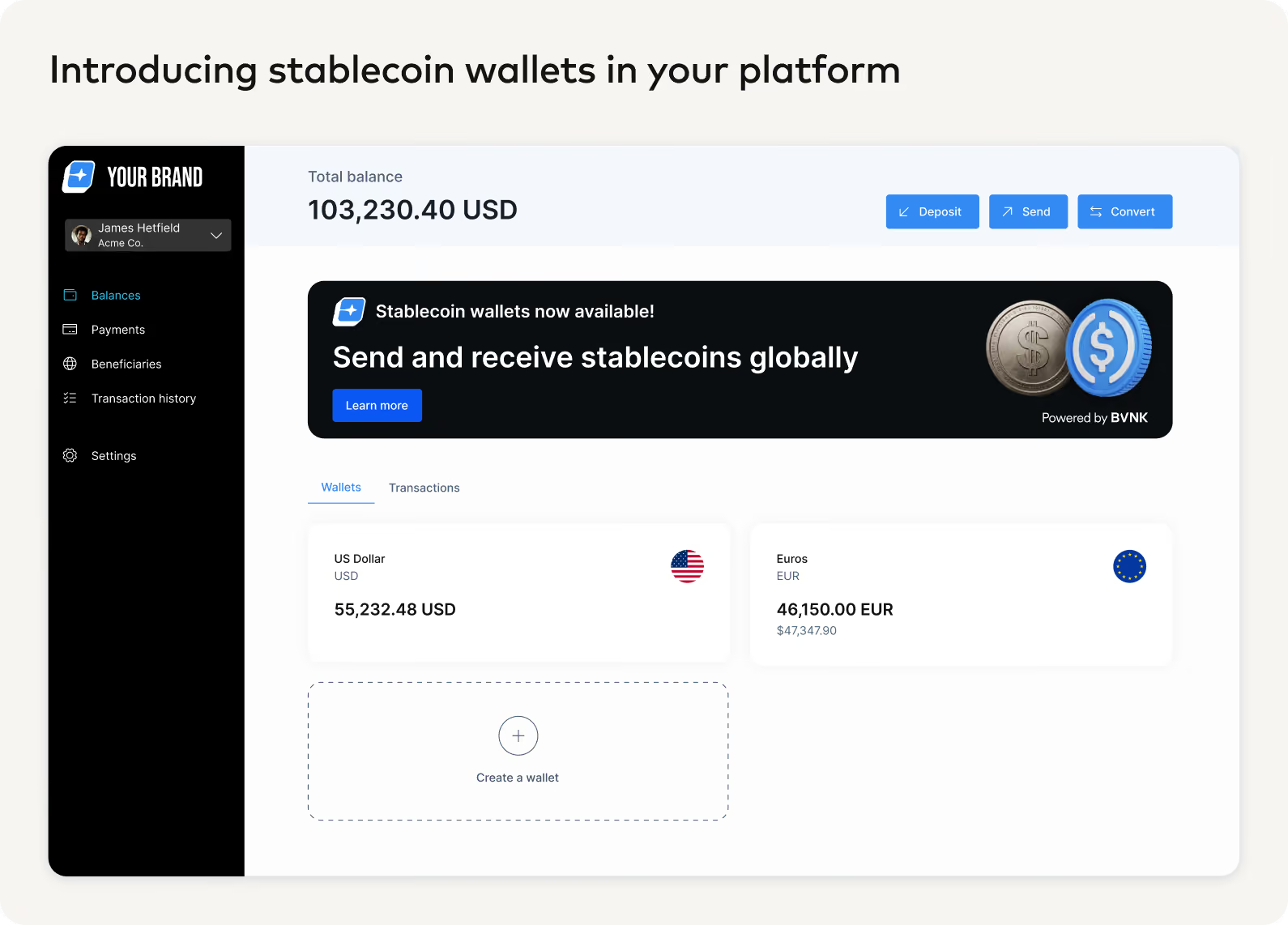
Exemplo de interface: apresentando carteiras de stablecoin aos seus usuários.