3 stages of stablecoin payments maturity – and how to evolve yours
.jpg)
Whether you’re a financial institution, fintech, payment processor, or tech platform, your approach to stablecoins changes as you scale – so too should your infrastructure.
Today, most stablecoin providers offer one of two models: fully managed (fast to market, but limited control) or infrastructure-only (more control, more complexity). That binary choice locks you into your approach upfront. But as your business matures and your volume scales, your needs are likely to shift. The question isn't which stablecoin infrastructure model is “better” – but which model fits where you are right now.
At BVNK, we experienced this ourselves early on in our journey, as we migrated our business from an external blockchain software to our own inhouse infrastructure. This shift reduced our dependency on third parties, enabling us to scale more efficiently and better meet our customers’ needs.
Now, we support our customers to do the same if it makes sense for their business, helping them move from a BVNK-managed service to running their operations inhouse on top of BVNK’s self-managed infrastructure.
In this article, we'll cover the three stages of stablecoin payments maturity that we typically see – and how different types of infrastructure can support you at each stage.
Stage 1: Launch – speed to market
What's happening: You're building a new capability. You need to move fast. Whether that's adding stablecoin payouts, wallets or conversion to your platform, time to market matters.
Your infrastructure priorities at this stage:
- Go live in weeks, not quarters
- Avoid having to acquire your own digital asset licensing
- Minimize operational complexity
- Let someone else handle custody, compliance, liquidity, banking connectivity
- Focus your team on your product and customer experience, not building infrastructure
The trade-off: You opt for a managed payments model, outsourcing some operational control, but in return you get speed, reliability, simplicity and built-in licensing and compliance.
Who typically stays here: Companies where stablecoins are a capability, not the core business: a merchant offering crypto checkout, a marketplace offering near-instant payouts to sellers. You need the functionality but you don't need to own the plumbing.
How BVNK supports you in this stage: Access our regulatory licenses, custody, compliance, liquidity network, and banking partners. Launch quickly using our hosted payments page and merchant portal, or embed stablecoin payments and wallets in your platform via API.
Stage 2: Scale – grow and learn
What’s happening: You’re processing real volume and in doing so, you're learning what matters to your business and your customers, as well as which partners you prefer and where you want more operational control. You might be hitting regulatory or operational thresholds that make you think about your infrastructure differently.
Your infrastructure priorities at this stage:
- Maintain the speed you had at launch
- Start taking operational control in specific areas
- Understand your dependencies (custody, liquidity, compliance)
- Keep flexibility as you figure out what matters
The trade-off: You're still using managed payments, but you're learning what level of operational control matters to your business.
Who typically stays here: Mid-market fintechs and payment processors who’ve proven the model and are comfortable outsourcing infrastructure. Some businesses stay here indefinitely because it works for them.
Who moves forward: Licensed institutions, stablecoin issuers, or payment companies building stablecoins as core product differentiation. For them, owning infrastructure becomes strategic.
How BVNK supports you in this stage: The same managed payments service. We’re here when you're ready to explore moving to self-managed.
When you’re ready to run stablecoin payments inhouse
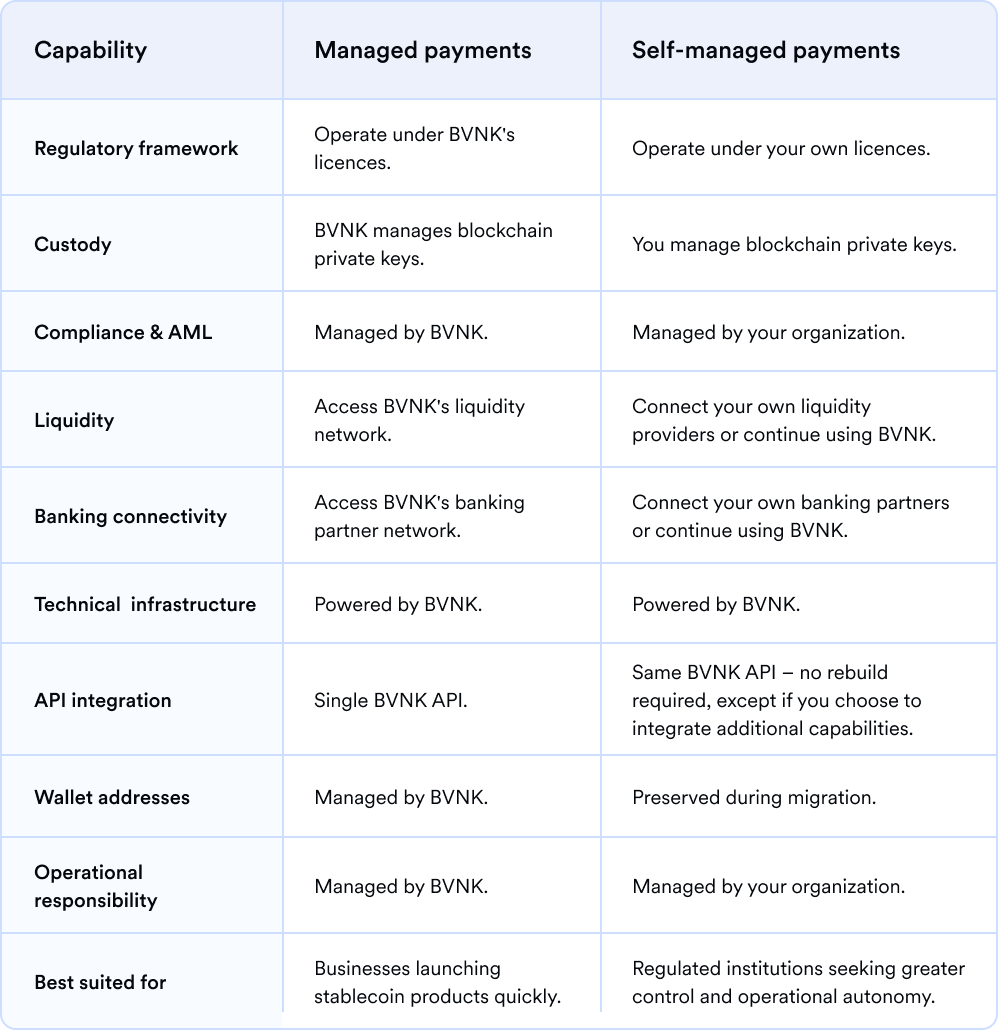
As you scale and learn, you might realize you need more control over custody, liquidity, or compliance. That’s the signal that it's time to consider moving to self-managed infrastructure.
Before you transition, you should typically have:
- Relevant digital asset regulatory licenses for the markets you serve.
- An established compliance and AML program.
- A custody and key management strategy.
- Preferred banking, liquidity and compliance providers selected.
- Operational readiness to manage payments under your own regulatory framework.
Stage 3: Operate – full control
What’s happening: You have your own regulatory licenses. You've built operational capacity. Stablecoins are now the core infrastructure for your business. You want full control over custody, liquidity partnerships, compliance, and risk appetite.
Your infrastructure priorities at this stage:
- Own your infrastructure end-to-end.
- Control your key relationships (custody, liquidity, banking).
- Manage your own regulatory and compliance posture.
- Maintain flexibility to evolve as your business scales.
The trade-off: You own the operational complexity. You need the headcount and expertise to run it. The upside is cost efficiency, complete control and the ability to optimize for your specific business model.
Who gets here: Licensed financial institutions, payment processors, stablecoin issuers. Companies where the infrastructure is the business.
How BVNK supports you in this stage: There's no need to switch providers. Instead, you can graduate within BVNK to our self-managed model. You get access to our software infrastructure (APIs, payment engines, wallet orchestration), but you control the custody, liquidity, and compliance layer, plugging in your own providers as needed. You can also continue using specific BVNK services where they add value – including liquidity, fiat payments, and trading – while managing other capabilities independently. You pick what works for your business.
How the transition works
Moving from managed to self-managed requires careful orchestration, but with the right support it doesn’t have to mean disruption for you or your customers. BVNK works alongside our customers throughout with hands on support for planning, testing and migration to ensure a smooth transition.
Here's what the process looks like:
Step 1 – Environment preparation
Work with BVNK to configure your self-managed environment, establish your custody infrastructure and connect your preferred providers.
Step 2 – Secure key migration
BVNK securely replicates your existing private keys into your self-managed vault. We then validate and reconcile to confirm all keys transferred successfully and wallet addresses remain unchanged. Once verified, the original keys are securely removed from BVNK systems.
Step 3 – Operational handover
Operational responsibility transfers to your organization. You begin operating under your own framework while continuing to use BVNK’s payment infrastructure and any selected services.
Not everyone follows the same path
Some businesses launch at Stage 1 and stay there. A platform offering stablecoin features doesn't necessarily need to become a licensed payment processor. An financial instiution might launch at Stage 2 because they already have regulatory licenses. The stage you operate at depends on whether stablecoins are strategic infrastructure for your business. What matters is that your infrastructure provider supports wherever you are – and wherever you want to go.
Want to understand where you are in your maturity journey and the best-fit infrastructure for you? Download our stablecoin readiness checklist.
.jpg)
.jpg)

.jpg)

.avif)


.avif)







.avif)


.avif)





.avif)

.avif)




.avif)






.avif)

.avif)



.avif)


.avif)



.avif)


.avif)


.avif)
.avif)


.avif)


.avif)


.avif)



Never miss an insight.